Delmarva Index
ESRGC · May 2019 - Present
A searchable catalog of data and tools for economic and community development across the Delmarva Peninsula.
Background
Delmarva Index brings together data, dashboards, and other resources that support economic and community development across the Delmarva Peninsula. ESRGC develops the project in partnership with the Mid-Shore Regional Council and the Tri-County Council for the Lower Eastern Shore of Maryland, with support from the Rural Maryland Council through the Rural Maryland Prosperity Investment Fund.
The website serves as the central catalog for a broader collection of Delmarva Index tools. Residents, businesses, community organizations, and economic-development professionals can search and browse resources that would otherwise be distributed across many projects and providers. I have led the site's application development from its original release through a complete rebuild, including its data model, editorial workflow, search experience, and front-end design.
How it evolved
The first Delmarva Index was a relatively simple catalog. Its home page highlighted selected resources, while individual entries gave users access to datasets, dashboards, and external links. ESRGC also hosted some datasets directly through the site. Each resource could have only one type, one category, one source, and one link—a workable model for the initial collection, but one that became restrictive as the catalog expanded.
The project later experimented with greater community interaction by adding comments to resource pages. That work included several approaches to identifying contributors without imposing a burdensome registration process. In practice, comments saw limited use, and the team learned that visitors received more value from clear content and effective discovery than from social features.
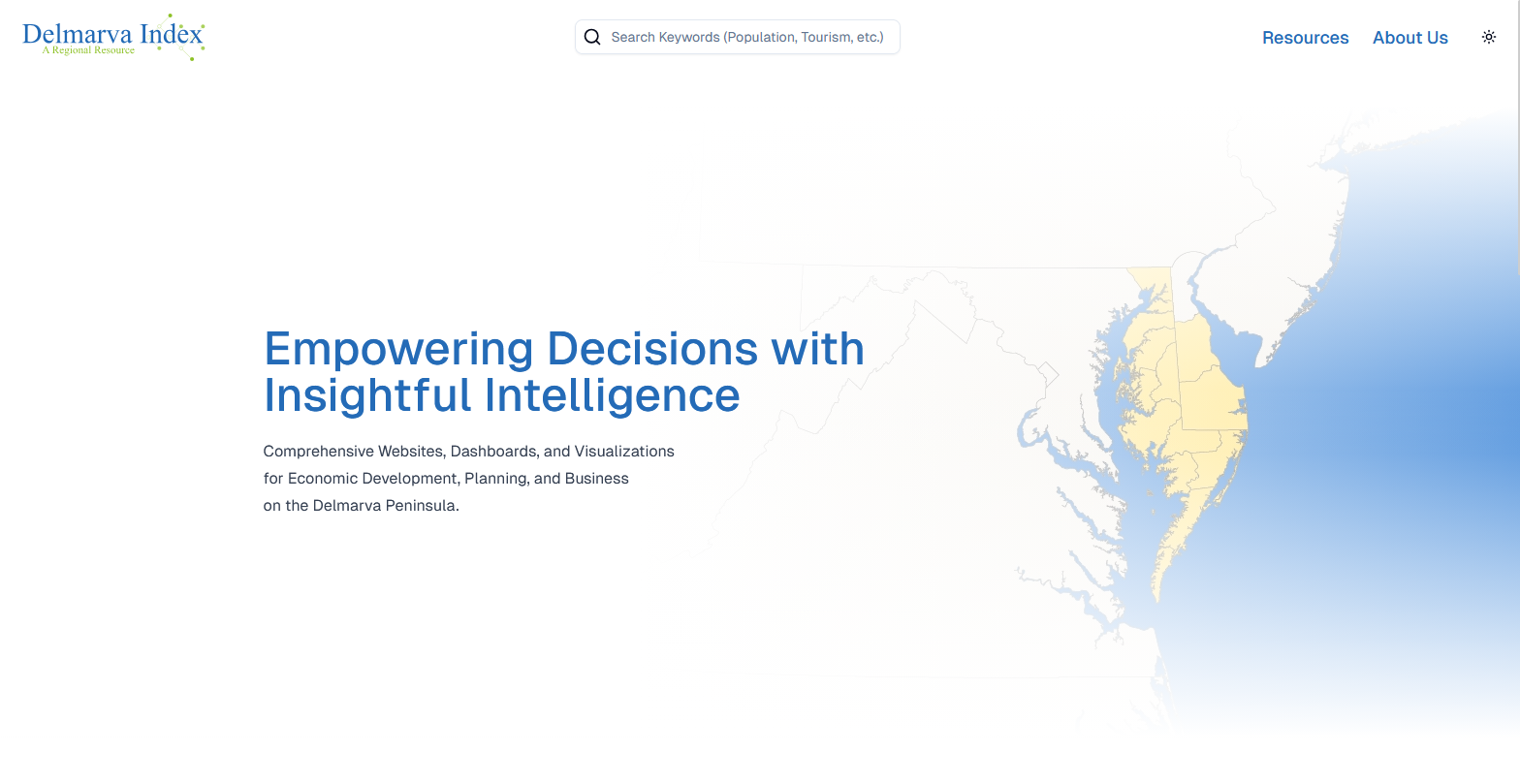
With new funding and several years of operational experience, we launched a complete 2.0 rebuild in September 2024. The new version replaced the rigid resource structure with a more flexible content model, significantly improved catalog search, and introduced a cleaner interface centered on navigation and readability. We intentionally removed underused features such as comments so the product could focus on its strongest role: helping our audience find and understand useful regional information.
Technical approach
I built the original site with Next.js during its early Zeit era, around version 8. The interface combined Bootstrap and Semantic UI, while a separate API evolved from REST to GraphQL. I selected MongoDB based on experience from LeadNursingForward. Because the catalog changed infrequently at first, I managed records directly through Postman before eventually building a custom administrative interface.
The commenting feature introduced a different design problem: allowing participation without asking occasional visitors to maintain another account. I initially tested Firebase Authentication with Google OAuth, then moved to a lighter workflow using email verification and browser fingerprinting when the partners decided full user accounts would add too much friction. Although comments were ultimately retired, the experiment helped clarify the project's priorities and reinforced the importance of matching authentication complexity to the actual value of a feature.
For the 2.0 rebuild, I chose PayloadCMS as the foundation rather than continuing to extend the custom admin panel. Payload had already proven effective on MUST Bus and LeadNursingForward, and its code-first model gave me both editorial flexibility and direct control over the application's schema. Resources can now reference multiple types, categories, sources, and links, accurately representing items that did not fit the original one-to-one structure.
Payload's block-based Lexical editor also lets editors compose richer resource pages, including specialized content such as FAQs, without requiring a new hard-coded field or admin screen for every variation. I retained MongoDB because the document-oriented model fit the dynamic page-builder content and because Payload's MongoDB adapter was its most mature database integration when the rebuild began.
The new interface uses Tailwind CSS and shadcn/ui to provide a consistent design system without competing visually with the catalog itself. Next.js continues to provide the application framework, while Docker gives the rebuilt site a repeatable deployment environment. Together, these choices reduced the amount of bespoke infrastructure I need to maintain and made both content changes and future application development substantially easier.
Challenges and lessons
Delmarva Index is distinctive in my portfolio because I was responsible both for its original architecture and for replacing that architecture years later. The first version was the first professional project I led from the beginning of its development cycle. I designed the schema and selected the stack independently, initially drawing heavily from technologies I already knew through LeadNursingForward. That approach helped me deliver a working product, but the site's growth exposed where familiarity had taken priority over the specific needs of the content.
Rebuilding the application gave me the opportunity to apply those lessons rather than simply criticize earlier decisions. The restrictive schema became a flexible model; the fragile custom administration tools became a purpose-built CMS; and features that did not demonstrate value were removed instead of carried forward by default. I approached the rewrite with a much clearer understanding of editorial workflows, maintainability, and the costs imposed by each new capability.
The result reflects an important part of my growth as a developer: the ability to evaluate my own past work honestly, preserve what still serves users, and redesign what no longer fits. Delmarva Index 2.0 is simpler for visitors, more capable for editors, and better positioned to support new regional resources without repeating the constraints of the original system.